On an east sill a wax plant reads 98 out of 100. The estimate for that spot is 6,500 lux, marked just right. Move the pot 60 cm into the room and it still reads 98; at 65 cm the light is marked a little dim and the verdict slips to worth a try, 69.
Read on 22 October 2026, the answer box at the top of Google’s results describes east as one of the “most forgiving” windows for a hoya, because cool morning sun rarely scorches. It gives no distance from the glass, and winter gets one line about a grow light. Below it come two Reddit threads, seen only as snippets, then care guides from Unsolicited Plant Talks, Plant Addicts, Clemson’s extension service, Hoya Treasures and Garden Design.
On scorch the box is right: east light never reads too bright for this plant, even on a June sill. Depth is where forgiving stops fitting. The great-fit strip at east glass is shallower than at south or west, and from October to early March it closes.

Great fit
This plant should be happy in this spot.
Just the right amount of light
Comfortable temperature
Humidity suits it
Airflow suits it
Is an east window bright enough for a hoya?
Published light figures for a hoya spread wide. Here they are, copied in whatever unit each source prints:
| Who publishes it | What it says a hoya needs | What the figure is |
|---|---|---|
| getgrowli.app | 4,000–8,000 lux | Growli's 'Bright Indirect' tier for hoya, the same band it prints for several other plants |
| getgrowli.app | 400–800 fc | The same tier, given in foot-candles |
| foliage-factory.com | approx. 10,000–20,000 lux | Care summary on the product page for Hoya carnosa 'Compacta', light at leaf level |
| foliage-factory.com | approx. 10,000–20,000 lux | Care summary on the product page for Hoya carnosa 'Tricolor' |
| extension.illinois.edu | 300 foot candles | Tier figure: wax plant is listed under High or Bright light, which the page sets at this level |
| mrec.ifas.ufl.edu | 125 foot-candles | Minimum for indoor spaces, for about 10 hours a day. Read from a web.archive.org snapshot of 13 August 2025; the live page now returns 404 |
| mrec.ifas.ufl.edu | 1500-2000 foot-candles | Light for commercial production, from the same archived page |
| bloomingexpert.com | 1,500–2,000 foot-candles | Second-hand: attributed to The Sill, whose hoya page now returns 404, so not checked at the original |
On the sill, from mid-March to September, yes. Growli’s band starts at 4,000 lux, low enough to pass the spot a metre from east glass at 5,000. Our band for a wax plant starts higher, between the 5,878 lux of the 65 cm row below and the 6,015 of the 60 cm row, which is why that metre spot reads only a little dim here. Read against Growli, an east room looks roomier than it scores.
Blush and new flower spurs, which the box also mentions, aren’t things the score measures. It reads light, warmth, humidity and airflow, and on the card above all four sit in their bands.
How far from an east window can a hoya go?
Sixty centimetres for a great fit, just under two feet. The table walks one wax plant back from the glass:
| Distance from the glass | Estimated light | What the light is doing | Verdict |
|---|---|---|---|
| 0.3 m, against the glass | 6,500 lux | Just the right amount of light | Great fit, 98/100 |
| 0.6 m back | 6,015 lux | Just the right amount of light | Great fit, 98/100 |
| 0.65 m back | 5,878 lux | A little dim, but workable | Worth a try, 69/100 |
| 1 m back | 5,000 lux | A little dim, but workable | Worth a try, 67/100 |
| 2 m back | 3,150 lux | A little dim, but workable | Worth a try, 64/100 |
| 3 m back | 1,984 lux | Too dim here | Not the best fit right now, 47/100 |
Five centimetres separate a great fit from worth a try: 6,015 lux on one side, 5,878 on the other. Beyond the step the score sinks only slowly, to 67 at one metre and 64 at two metres. By three metres the light has run out: 47, too dim.
That makes east the tightest of the three bright windows for this plant. West glass keeps a wax plant at a great fit to about a metre back, south glass to about two, and a north sill never gets it there. A string of hearts at the same east glass keeps its great fit to the same 60 cm.
The step matters most for a hoya grown in a hanging basket. Hung from a ceiling hook a metre in from the glass, it reads 67; hung over the sill, it stays in the band. Height isn’t an input here, only distance from the glass. The lux column is a model of an east pane under a cloudless sky, scaled for each step back from the glass; no meter was involved.
Is an east window enough for a hoya in winter?
Not from October to early March, at latitude 40, which runs through Philadelphia and Madrid. Six dates through the year, on the same sill as the card:
| The month | Estimated light | What the light is doing | Verdict |
|---|---|---|---|
| February | 5,019 lux | A little dim, but workable | Worth a try, 67/100 |
| March | 6,455 lux | Just the right amount of light | Great fit, 98/100 |
| June | 7,800 lux | Just the right amount of light | Great fit, 99/100 |
| September | 6,477 lux | Just the right amount of light | Great fit, 98/100 |
| October | 4,924 lux | A little dim, but workable | Worth a try, 67/100 |
| December | 3,250 lux | A little dim, but workable | Worth a try, 64/100 |
June reads 7,800 lux and 99, still marked just right. By 21 October the sill is down to 4,924 lux and scores 67, and December sits lowest, at 3,250 lux and 64. Day by day, the great fit on the sill runs from 12 March to 30 September, so for more than five months a hoya on an east sill is a little short of light even in the brightest spot the room has.
Those dates hardly shift with latitude. At 30 degrees north, around Houston or Cairo, the run is 9 March to 3 October; at 50 degrees, around Frankfurt or Winnipeg, it is 15 March to 27 September. What summer adds is depth: from 22 April to 20 August a pot a metre back reads a great fit as well. Winter takes depth away at the far end, and from 8 November to 2 February a pot two metres back reads too dim.
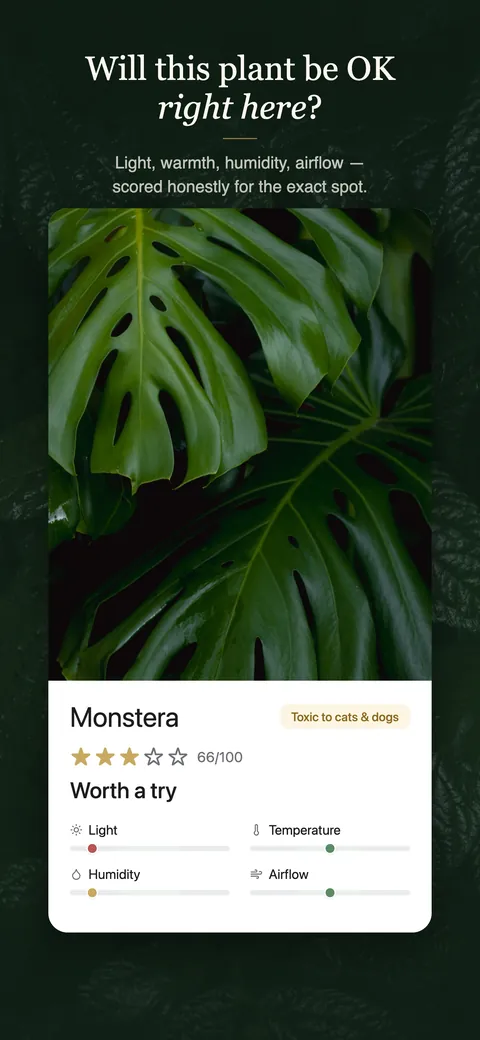
So the box’s grow-light tip comes with a calendar: October to early March, at any latitude in that range. A lamp that brings the light at the leaves above the 6,015 lux of the 60 cm row puts the card back where March has it. Cold glass works against the plant in the same months. Below 13 °C at the sill the score falls into not the best fit.
What window should a hoya be in?
One where it can sit inside its strip. South glass gives a wax plant the most floor, west about half as much, east 60 cm, and north no great-fit floor at all. That makes east a good window for a hoya that can live on the sill, and a poor one for a plant that has to live across the room. A full sill isn’t the end of it: a shelf or stand pressed up to the glass counts, as long as the leaves end up within those 60 cm.
The east window guide puts hoyas with the plants that belong right in the morning beam, and the numbers agree. What they add is the calendar: from October the sill is still the right place for the pot, just not a perfect one.
Before you commit the spot
All of this assumes a clear view east on a cloudless morning. A wall across a narrow gap, a tree in leaf or a deep window reveal cuts the light at the sill, and a strip 60 cm deep has little room to give any up. None of those is in our estimate. For your own window, the free spot checker will score it with local weather.
Published October 22, 2026
