A wax plant on a north sill reads 65 out of 100, a worth-a-try verdict. The estimate there is 3,640 lux, which the score marks a little dim, and nothing further into the room is brighter. It keeps that verdict for 1.7 metres. At 1.75 the light is too dim and the card falls to 47.
Read on 22 October 2026, the answer box at the top of Google’s results is short. Citing Hoya Treasures, it says a hoya can survive a north window but will grow slowly and is unlikely to flower without extra light. The forum threads under it, seen only as search snippets, agree: on Facebook the top answer is to add a grow light, and on Reddit a reply suggests carnosa or pubicalyx, warning they may need more light to bloom.
None of it puts a distance on where the light runs out, or says that the choice of hoya can matter more than the lamp. Our numbers speak to both.

Worth a try
It can work here with a little care.
A little dim, but workable
Comfortable temperature
Humidity suits it
Airflow suits it
Can a hoya survive in a north-facing window?
Survive is the right word for a wax plant. Before our numbers, here is what other sites print for a hoya’s light, each in its own unit:
| Who publishes it | What it says a hoya needs | What the figure is |
|---|---|---|
| getgrowli.app | 4,000–8,000 lux | Growli's 'Bright Indirect' tier for hoya, the same band it prints for several other plants |
| getgrowli.app | 400–800 fc | The same tier, given in foot-candles |
| foliage-factory.com | approx. 10,000–20,000 lux | Care summary on the product page for Hoya carnosa 'Compacta', light at leaf level |
| foliage-factory.com | approx. 10,000–20,000 lux | Care summary on the product page for Hoya carnosa 'Tricolor' |
| extension.illinois.edu | 300 foot candles | Tier figure: wax plant is listed under High or Bright light, which the page sets at this level |
| mrec.ifas.ufl.edu | 125 foot-candles | Minimum for indoor spaces, for about 10 hours a day. Read from a web.archive.org snapshot of 13 August 2025; the live page now returns 404 |
| mrec.ifas.ufl.edu | 1500-2000 foot-candles | Light for commercial production, from the same archived page |
| bloomingexpert.com | 1,500–2,000 foot-candles | Second-hand: attributed to The Sill, whose hoya page now returns 404, so not checked at the original |
Growli’s band for a hoya starts at 4,000 lux, and our estimate for a north sill, 3,640, sits just under it. The score puts the sill in the same place: worth a try, and the light is the only thing marked short, with warmth, humidity and airflow all comfortable at 22 °C and 50% humidity. A carnosa can live there. It just never scores the way it does behind brighter glass.
Our care data sides with Illinois Extension, which lists the wax plant in its high or bright tier. Its entry for a carnosa asks for lots of bright, indirect light, and that is more than a north sill hands over.
Flowering isn’t something the score measures, so we can’t confirm or rule out the box’s warning about blooms.
How far from a north window can a hoya go?
About 1.7 metres, five and a half feet. The same wax plant, moved back from north glass:
| Distance from the glass | Estimated light | What the light is doing | Verdict |
|---|---|---|---|
| 0.3 m, against the glass | 3,640 lux | A little dim, but workable | Worth a try, 65/100 |
| 1 m back | 2,800 lux | A little dim, but workable | Worth a try, 64/100 |
| 1.5 m back | 2,222 lux | A little dim, but workable | Worth a try, 63/100 |
| 1.7 m back | 2,026 lux | A little dim, but workable | Worth a try, 62/100 |
| 1.75 m back | 1,980 lux | Too dim here | Not the best fit right now, 47/100 |
| 3 m back | 1,111 lux | Too dim here | Not the best fit right now, 46/100 |
From the sill to 1.7 metres the score slides only from 65 to 62, while the light falls from 3,640 to 2,026 lux. Five centimetres further, at 1,980 lux, the light column changes to too dim and the card drops to 47. After that it barely moves: 46 at three metres.
So the sill and a shelf a metre in read almost the same, and the far side of a deep room is where a hoya runs short. Those lux figures are arithmetic rather than readings: a north pane, a cloudless sky, the pot’s distance, and no particular date. The next section adds the dates.
Should a hoya move closer to a north window in winter?
Yes, by early October if it sits 1.5 metres back or more. Scored for latitude 40, roughly Denver’s or Beijing’s, the edge of the workable strip sits about 2.1 metres from the glass in June, 1.7 at the equinoxes and 1.25 in late October. By December it is down to 55 centimetres.
Put as dates: a pot 1.5 metres back reads too dim from 7 October to 5 March, and one a metre back from 7 November to 3 February. Only the first half-metre stays worth a try all year round. The sill itself never reaches a great fit in any month, so in winter the plant needs to be at the glass, not near it.
Which hoya does best in a north window?
One filed for less light. Six hoyas on the same north sill:
| Hoya type | What the light is doing | Verdict |
|---|---|---|
| Wax plant (Hoya carnosa) | A little dim, but workable | Worth a try, 65/100 |
| Hoya pubicalyx ‘Royal Hawaiian Purple’ | A little dim, but workable | Worth a try, 65/100 |
| Hindu rope (Hoya carnosa ‘Compacta’) | A little dim, but workable | Worth a try, 65/100 |
| Sweetheart hoya (Hoya kerrii) | A little dim, but workable | Worth a try, 65/100 |
| Fishtail hoya (Hoya polyneura) | Just the right amount of light | Great fit, 99/100 |
| Hoya bilobata | Just the right amount of light | Great fit, 99/100 |
The fishtail hoya and Hoya bilobata read 99 because our care data files them a band lower, for plain bright indirect light, so 3,640 lux lands inside their band instead of under it. The Reddit reply’s picks, carnosa and pubicalyx, read the same 65 as the sweetheart hoya and the Hindu rope.
At this window the plant is a bigger lever than the spot. Moving a carnosa from the sill to a metre back costs it one point; swapping it for a fishtail hoya takes the same sill from 65 to 99.
The fishtail also gets more room to work with. It keeps its great fit to 1.7 metres from north glass, right where a wax plant tips from worth a try to too dim, and at latitude 40 its sill score never leaves the great-fit band, December included. On a north sill it behaves like a moth orchid, which keeps a great fit about as far back.
Does a hoya in a north window need a grow light?
Not to stay worth a try; the first half-metre holds that all year. For a carnosa to score a great fit, it needs more light at the leaves than any north spot gives, about what an east sill gets from mid-March to September.
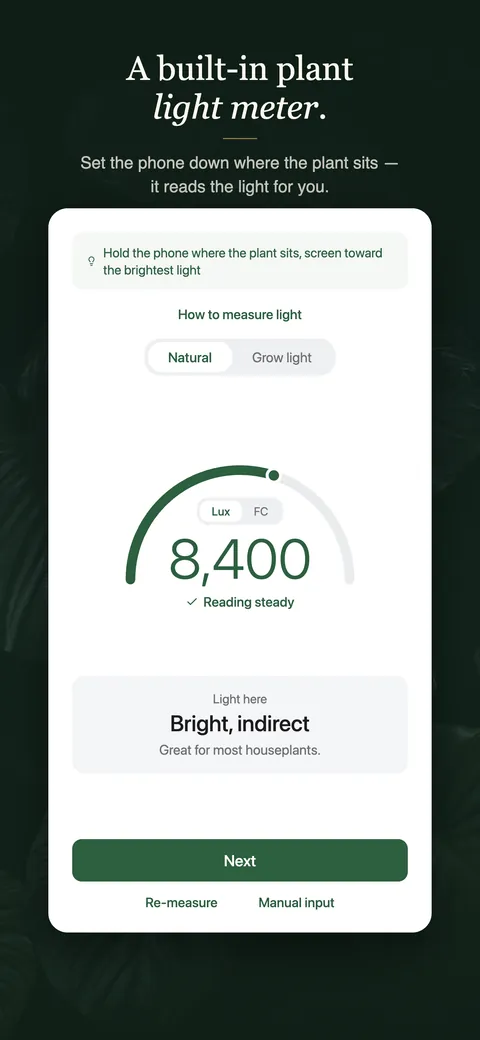
So the label won’t settle it; the number will. The north sill’s 3,640 lux is under half of a reading like that one, and the score can’t see a lamp, so take your reading at the leaves with the light switched on. A west room or a south one gives a carnosa that light without a lamp, if you have the choice.
Before you commit the spot
All of this assumes an unobstructed north view and clear weather. A building a few metres across the street, a balcony overhead or a net curtain takes light off a sill that has little to spare, and none of them is in our estimate. Cold counts too: once the air at the glass dips below 13 °C, the sill drops a band, to not the best fit. The north window guide collects plants that ask less of this light, and the free spot checker will run your own window through the same score, with local weather.
Published October 22, 2026
