An indoor yucca, the spineless yucca sold as a cane, reads its light just right from about 6,000 to 26,400 lux on our scores, about 557 to 2,450 foot-candles; a rubber plant shares the band. A south sill gives it on every day of the year at latitude 40, and the band holds to about 2.1 m back from the glass. A west sill gives it to about a metre back and an east sill to about 0.6 m, and both only from late winter to autumn; a north sill reads a little dim all year. The garden yuccas, Adam’s needle and the Spanish bayonet among them, sit a band higher, a band no windowsill gives at latitude 40. The card below is a spineless yucca right on a west sill at 21 °C and 40% humidity and scores 99 out of 100. The lux behind each verdict is modelled for a clear day from the compass direction, the distance and the date, not measured in your room.
Great fit
This plant should be happy in this spot.
Just the right amount of light
Comfortable temperature
Humidity suits it
Airflow suits it
Read on 23 November 2026, Google’s answer box for how much light a yucca plant needs gives bright, indirect light indoors, ideally near a south or west window, with an east window for gentler morning light. It adds that indoor yuccas such as the spineless yucca want only short spells of direct sun, and that in low light they grow slowly and lean. On our scores a south sill is the one window that holds the band all year; a west or east sill holds it from late winter to autumn.
Which window is best for a yucca?
South in winter; south, east or west in summer. Here is a spineless yucca at seven spots, without a date:
| Where it stands | Estimated light | What the light is doing | Verdict |
|---|---|---|---|
| North sill, against the glass | 3,640 lux | A little dim, but workable | Worth a try, 65/100 |
| East sill, against the glass | 6,500 lux | Just the right amount of light | Great fit, 98/100 |
| 1 m back from an east window | 5,000 lux | A little dim, but workable | Worth a try, 67/100 |
| West sill, against the glass | 7,800 lux | Just the right amount of light | Great fit, 99/100 |
| South sill, against the glass | 13,000 lux | Just the right amount of light | Great fit, 100/100 |
| 2 m back from a south window | 6,300 lux | Just the right amount of light | Great fit, 98/100 |
| 3 m back from a south window | 3,969 lux | A little dim, but workable | Worth a try, 66/100 |
Given dates, at latitude 40 a south sill holds the band on every day of the year; a metre back it reads a little dim only from 29 May to 14 July. A west sill is a great fit from 21 February to 19 October and an east sill from 12 March to 30 September, and both read a little dim the rest of the year; a north sill reads a little dim on every day. That is the RHS’s advice: a south-facing window in winter, an east or west one in summer. The pages we read put it this way:
| Who publishes it | What it says a yucca needs | What the figure is |
|---|---|---|
| rhs.org.uk | Indoors bright, filtered light | Its aspect indoors; outdoors full sun to light shade |
| rhs.org.uk | A south-facing window would be ideal in winter | With an east or west-facing window in summer |
| rhs.org.uk | Provide light shade from direct summer sun | Indoors, and ventilate freely |
| houseplantshop.com | a bright, sunny spot | Where to put a yucca indoors |
| houseplantshop.com | indirect but bright light | What it prefers |
| costafarms.com | bright or medium light | What a yucca cane prefers |
| costafarms.com | tolerates low-light conditions well | In low light it grows more slowly |
| plants.ces.ncsu.edu | Full sun (6 or more hours of direct sunlight a day) | One of its two light categories, with partial shade |
Costa Farms says a yucca cane tolerates low light well; on our scores it reads worth a try, a little dim, from 2,000 to 5,999 lux and not the best below that, so a north room holds it at worth a try only within about 1.7 m of the glass. The RHS adds that low light can make the leaves sag, which is the dim end of the same band.
Does a yucca need more light than a dragon tree?
Yes, and less than a ponytail palm. Here are four spiky indoor trees right on the same south sill:
| The plant | What the light is doing | Verdict |
|---|---|---|
| Ponytail palm (Beaucarnea recurvata) | A little dim, but workable | Worth a try, 67/100 |
| Spineless yucca (Yucca gigantea) | Just the right amount of light | Great fit, 100/100 |
| Ti plant (Cordyline fruticosa) | Just the right amount of light | Good fit, 85/100 |
| Dragon tree (Dracaena marginata) | A bit bright, but workable | Worth a try, 67/100 |
The ponytail palm reads a little dim even there, the light is just right for the spineless yucca and the ti plant, and the dragon tree reads a bit bright. NC State Extension’s plant toolbox sorts them the same way: full sun only for the ponytail palm, full sun or partial shade for the spineless yucca, dappled sun, partial or deep shade for the ti plant, and dappled sun or deep shade for the dragon tree. It takes one step more than our data does, putting the yucca a step above the ti plant, where our data has the two in one band.
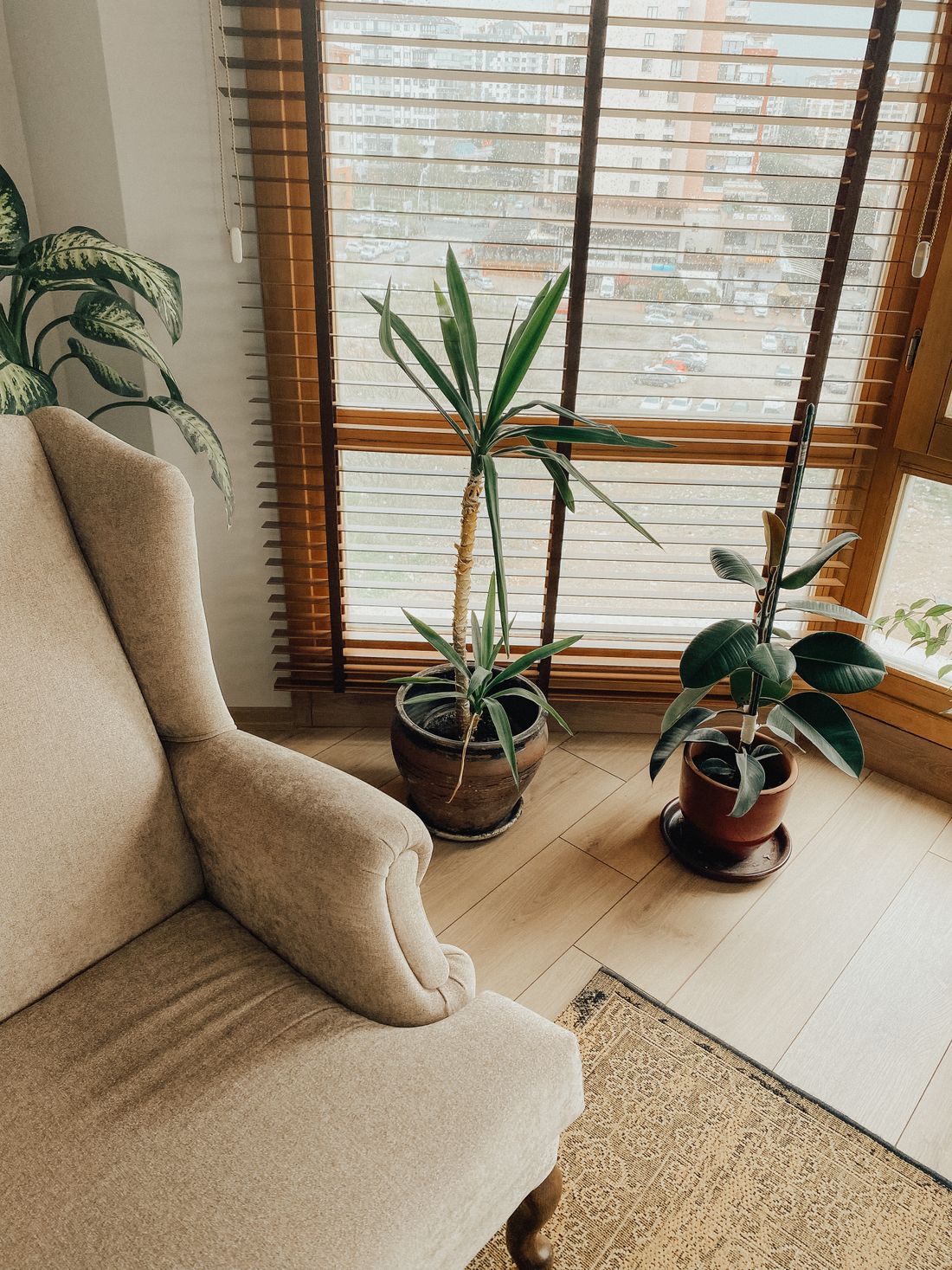
What temperature does a yucca like?
Room temperature, kept above 13 °C. On our scores a spineless yucca is a great fit from 18 to 28 °C (about 64 to 82 °F), worth a try from 13 to 17.9 °C, and not the best below 13 °C, about 55 °F; above 32 °C, about 90 °F, it reads too hot. The RHS gives tender yuccas a minimum night temperature of 7 °C and the spineless yucca a minimum of 10 °C in its cultivar notes; both are survival figures, and both read not the best on our scores. Its humidity reads just right from 30 to 70%, and a little dry below that, down to 15%. For a spot you can’t picture, the free spot checker scores a yucca against your local weather.
Published November 23, 2026
