A corn plant scores 100 out of 100 on a north sill at 22 °C and 50% humidity, and so do the dragon tree, Dracaena marginata, and lucky bamboo. Each keeps a great fit to 1.7 m back. Put a Canary Islands dragon tree on that sill and its light reads a little dim.
Read on 28 November 2026, Google’s answer box says a dracaena can get by near a north window and often does well, the dark green kinds above all, if slowly. Keep it by the glass or within a few feet, it says, citing Reddit and Low Light Leaf. Crediting Plant Addicts, it names Janet Craig and Compacta as dark green types that cope with lower light better than variegated ones, which fade. For narrow new leaves or yellowing lower ones it suggests a grow light. Nobody on the first page gives lux.
Our care data gives Janet Craig, Compacta and the variegated corn plants their species’ light band, so the score can’t test that colour advice either way. It can show how far each species reaches into the room.

Great fit
This plant should be happy in this spot.
Just the right amount of light
Comfortable temperature
Humidity suits it
Airflow suits it
Does a dracaena get enough light at a north window?
At the glass, comfortably. First, the light figures other sites publish for a dracaena, each in its source’s own unit:
| Who publishes it | What it says a dracaena needs | What the figure is |
|---|---|---|
| houseplantjournal.com | 100 FC (20 µmol) | Minimum indirect light for dracaenas (several species) |
| houseplantjournal.com | 200 FC (40 µmol) | Good indirect light for dracaenas |
| houseplantjournal.com | 30-50 FC | Where the writer saw one last for years, long, thin and spindly |
| libguides.nybg.org | about five to six feet from a bright south-facing window | Far enough that the sun’s direct rays don’t touch it |
| plantaddicts.com | three to five feet away from a west-facing window | To keep the afternoon sun from burning the leaves |
Houseplant Journal writes its figures for dracaenas in general, and the other two rows are distances from a south window and a west one, so none of them is written for north light. Its foot-candles can still be placed in a north room. The good level, 200 foot-candles, lands between the 1 m and 1.7 m rows of the walk-back table further down, and the 100-foot-candle minimum just past its 3 m row. The 30 to 50 foot-candles where its writer saw one last for years is dimmer than any row in that table.
On our scale the north sill is no compromise for a corn plant. Its light reads just right there, and the card above puts the sill at 100; the answer box is more cautious about that spot than our numbers are. Its caution belongs further back in the room.
Which dracaenas suit a north sill?
Most of the ones people buy. Here is the corn plant beside other species sold as dracaenas, set in turn on one north sill:
| Which dracaena | What the light is doing | Verdict |
|---|---|---|
| Corn plant (D. fragrans) | Just the right amount of light | Great fit, 100/100 |
| Dragon tree (D. marginata) | Just the right amount of light | Great fit, 100/100 |
| Lucky bamboo (D. sanderiana) | Just the right amount of light | Great fit, 100/100 |
| Canary dragon tree (D. draco) | A little dim, but workable | Worth a try, 65/100 |
| Snake plant (D. trifasciata) | Just the right amount of light | Great fit, 99/100 |
The corn plant, the dragon tree and lucky bamboo all score 100, and the snake plant 99. The Canary Islands dragon tree, Dracaena draco, drops to 65, its light a little dim, because our care data files it for brighter light than any other plant in the table. Even the sill is a compromise for it, and 1.75 m back it is already not the best fit.
Both species get sold as dragon tree, and the Canary Islands one is the plant the south-window page puts right against the glass.
How far back from north glass can a dracaena go?
About 1.7 m for a corn plant. Here it is walked back from the glass:
| Distance from the glass | Estimated light | What the light is doing | Verdict |
|---|---|---|---|
| 0.3 m, against the glass | 3,640 lux | Just the right amount of light | Great fit, 100/100 |
| 1 m back | 2,800 lux | Just the right amount of light | Great fit, 99/100 |
| 1.7 m back | 2,026 lux | Just the right amount of light | Great fit, 98/100 |
| 1.75 m back | 1,980 lux | A little dim, but workable | Worth a try, 69/100 |
| 3 m back | 1,111 lux | A little dim, but workable | Worth a try, 65/100 |
| 4.35 m back | 595 lux | Too dim here | Not the best fit right now, 47/100 |
It holds a great fit to 1.7 m, where the estimate is 2,026 lux, and five centimetres further, at 1,980 lux, it drops to 69, worth a try. The dragon tree and lucky bamboo take that step at 1.75 m too, and reach not the best at 4.35 m. So the answer box’s few feet is about right: 1.7 m is roughly five and a half feet.
The snake plant goes much deeper. On our scores it is still a great fit six metres from north glass, and its own north-window page is mostly about winter.
Every lux figure here is the model’s clear-day estimate for open north glass at that distance. None of it was measured.
Does a dracaena need to move in for winter?
Only if it lives more than about half a metre from the glass. At latitude 40, roughly New York or Madrid, the sill keeps its great fit on every day of the year, but the strip behind it shrinks with the days. On 28 November the great fit ends 65 cm from the pane, and on 21 December at 55 cm; on 21 June it runs to 2.1 m. A pot a metre back loses its great fit from 7 November to 3 February, when its light reads a little dim. A pilea shares this band, and its north-window page follows the same strip of floor through every month.
Further north even the sill falls short. At 51.5 degrees, London’s latitude, it reads a little dim from 13 November to 28 January. That is where the answer box’s grow light earns its place: a pot past those lines in midwinter, or a corn plant on a London north sill.
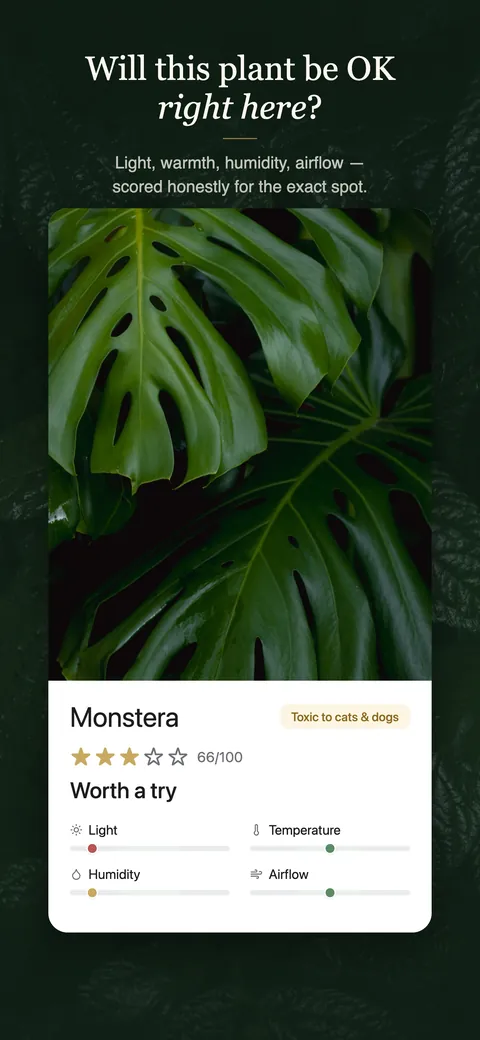
Coming forward for winter also brings the pot nearer the coldest air in the room. On our scale a corn plant’s comfortable range starts at 18 °C, and the dracaena light page sets the rest of that range beside its light band in lux.
What do these north-window numbers leave out?
Shade. They are for a north window with nothing outside it but sky. A wall across a light well or a balcony above the glass takes light off every row, and a north window has little to spare. The north window guide has the plants that cope with less, and the free spot checker will score the shelf you actually have.
Published November 28, 2026
