Right at south glass, where the model puts 13,000 lux on a clear day, the card below scores a green Chinese evergreen 45 out of 100: not the best fit right now, its light too bright. One metre back the score is 63 and two metres back 68, both still flagged. The flag lifts at 2.45 m, where the score jumps to 98.
Read on 28 November 2026, Google’s results open with an answer box saying a Chinese evergreen can do well near a south window, as long as you filter the sun or step back from it. Citing Toronto Master Gardeners, it warns that direct sun at the glass can scorch the leaves, and it suggests a few feet from the glass or a sheer curtain. Bleached or scorched patches mean too much sun, it adds, and slow, leggy growth too little. None of the results under it gives a figure in lux.
Stepping back is the right call. What the box leaves out is how far, and in which months the distance matters.

Not the best fit right now
The plant's fine, this spot just isn't a match.
Too bright here
Comfortable temperature
Humidity suits it
Airflow suits it
Light is a deal-breaker here. The other three cannot make up for it.
Can a Chinese evergreen take direct sun in a south window?
The figures other sources publish for its light, each in the unit its source uses:
| Who publishes it | What it says a Chinese evergreen needs | What the figure is |
|---|---|---|
| getgrowli.app | 500–800 lux | The floor it gives: what the plant survives on in a north room or dim corner (its Low Light tier) |
| getgrowli.app | 1,500–4,000 lux | Where it says the plant does noticeably better; Growli prints this same band for every plant in its medium indirect tier |
| getgrowli.app | ~50–75 fc; 150–400 fc foot-candles | Its foot-candle figures: survives down to the first, grows well at the second |
| foliage-factory.com | approx. 5,000–10,000 lux | Product page for Aglaonema commutatum, listed as medium indirect light |
| edis.ifas.ufl.edu | 3,000 to 1,250 foot candles | UF/IFAS EP160: commercial production under 75% to 90% shade, a nursery figure rather than a home one |
| edis.ifas.ufl.edu | 25 foot candles | UF/IFAS EP160: the lowest light level it says the plant can tolerate |
| extension.illinois.edu | 75 foot candles | A tier value: the page lists Chinese evergreen as low light and gives that tier one figure |
Not at the glass. The card gives the sill 45, and light is the line pulling it down: too bright here. The card’s other three lines are comfortable, so shade is the whole fix. Foliage Factory, which sells this species under its botanical name, tops its band at 10,000 lux. Our model puts that much light a metre from south glass, and 13,000 on the sill itself.
How far from a south window should a Chinese evergreen be?
Farther than a few feet. Here is one plant walked back from the same window on a clear day with no date:
| Distance from the glass | Estimated light | What the light is doing | Verdict |
|---|---|---|---|
| 0.3 m, against the glass | 13,000 lux | Too bright here | Not the best fit right now, 45/100 |
| 1 m back | 10,000 lux | A bit bright, but workable | Worth a try, 63/100 |
| 1.5 m back | 7,937 lux | A bit bright, but workable | Worth a try, 65/100 |
| 2 m back | 6,300 lux | A bit bright, but workable | Worth a try, 68/100 |
| 2.45 m back | 5,117 lux | Just the right amount of light | Great fit, 98/100 |
| 3 m back | 3,969 lux | Just the right amount of light | Great fit, 100/100 |
A metre back takes the light from too bright to a bit bright, and the score to 63. At 1.5 and 2 m it is still flagged, at 65 and 68, and the flag holds to 2.40 m. At 2.45 m the estimate is down to 5,117 lux and the score is 98.
So a few feet, read as three or four, suits a different plant. ‘Red Valentine’, one of the reds that read a great fit right on an east sill, sits a band higher in our care data. On this sill it reads only a bit bright, and it clears its flag 1.25 m back, about four feet, half what the green species needs. On 21 June it reads a great fit right at the glass.
Treat the lux column as the model’s figure for that compass direction and distance on a cloudless day; a meter in your own room will disagree with it somewhat.
Is a south window harsher in summer or winter?
The cooler half of the year, by a distance. Here is the two-metre spot through a year at latitude 40, about level with New York or Beijing:
| The 21st of | Estimated light | What the light is doing | Verdict |
|---|---|---|---|
| February | 6,776 lux | A bit bright, but workable | Worth a try, 67/100 |
| April | 5,047 lux | Just the right amount of light | Great fit, 98/100 |
| June | 3,547 lux | Just the right amount of light | Great fit, 100/100 |
| August | 5,025 lux | Just the right amount of light | Great fit, 98/100 |
| October | 6,765 lux | A bit bright, but workable | Worth a try, 67/100 |
| December | 5,960 lux | A bit bright, but workable | Worth a try, 68/100 |
June gives that spot 3,547 lux and a full 100. February and October give it nearly twice as much, and 67. Day by day, its great fit runs from 19 April to 24 August. Low sun from autumn to spring shines squarely into south glass, while the high June sun meets the pane at a steep angle.
The sill keeps the same calendar. From 21 August through 21 April it reads too bright and the rest of the year only a bit bright; on 21 June it gets the same verdict as an east sill. The line that matters moves with it: on 21 June the flag clears 1.2 m from the glass, while in mid-October and late February it holds to 2.55 m. Set the pot 2.6 m back, about eight and a half feet, and no day of the year flags it.
East and west glass run the other way, flagging this plant hardest in summer, and the west-window page finds that even its sill reads a great fit from early November to early February.
Can a sheer curtain stand in for the eight feet?
Only if it takes out most of the light, and these numbers can’t say whether yours does: a curtain isn’t one of their inputs. What they can say is how much it has to remove. The sill reads 13,000 lux and the first great-fit row 5,117, so on a clear day a sheer has to cut the light at the leaves by about three fifths to stand in for those eight feet.
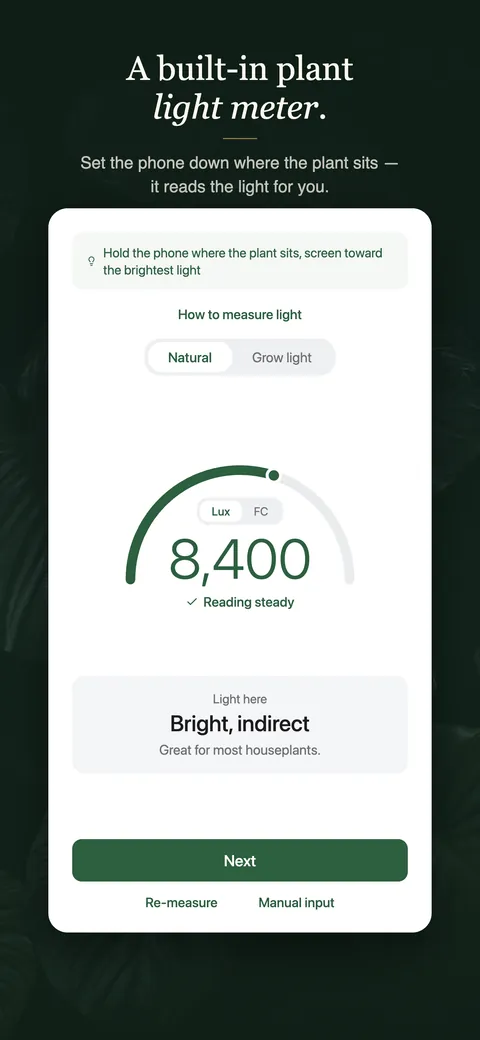
A reading like that sits between the one-metre and metre-and-a-half rows of the distance table. It is a bit bright for the green species and just right for ‘Red Valentine’, so the same number means move it for one plant and leave it for the other. Behind a sheer, take the reading at the leaves around midday on a clear day. For a green one you want it no higher than the 2.45 m row’s.
What else changes the answer at a south window?
Every number here assumes an unshaded south window on a clear day. An overhang or a balcony above takes the high summer sun before the low winter sun, so it can soften June and leave October much as it is; the tables above assume neither. The south window guide covers the plants that want that light. If you also have north glass, the north-window page finds that its sill suits a green one with no step back at all. The free spot checker runs this scoring on a spot you describe, using the weather where you are.
Published November 28, 2026
