Right on an east sill, a plain green Chinese evergreen, Aglaonema commutatum, scores 67 out of 100, its light marked a bit bright. ‘Red Valentine’ scores 93 in the same spot. Move both back and they trade places: three metres into the room the red one has slipped to 66, and the green one reads a great fit.
Read on 28 November 2026, Google’s answer box calls an east window one of the best spots for an aglaonema, with soft morning light and none of the midday heat. It suggests a few feet back from the glass, or close to it behind a sheer. Then it sorts by colour: pink, red and variegated kinds need brighter light, while deep green ones can sit dimmer and farther back. It also warns that direct sun through glass can burn the leaves. None of the pages ranked under it puts a lux number on any of this.
Our scores bear out the colour rule for the two reds we checked but not for the other coloured kinds, and they put distances on it.

Worth a try
It can work here with a little care.
A bit bright, but workable
Comfortable temperature
Humidity suits it
Airflow suits it
Is an east window too bright for a Chinese evergreen?
The published light figures for this plant come first, each in the unit its publisher chose:
| Who publishes it | What it says a Chinese evergreen needs | What the figure is |
|---|---|---|
| getgrowli.app | 500–800 lux | The floor it gives: what the plant survives on in a north room or dim corner (its Low Light tier) |
| getgrowli.app | 1,500–4,000 lux | Where it says the plant does noticeably better; Growli prints this same band for every plant in its medium indirect tier |
| getgrowli.app | ~50–75 fc; 150–400 fc foot-candles | Its foot-candle figures: survives down to the first, grows well at the second |
| foliage-factory.com | approx. 5,000–10,000 lux | Product page for Aglaonema commutatum, listed as medium indirect light |
| edis.ifas.ufl.edu | 3,000 to 1,250 foot candles | UF/IFAS EP160: commercial production under 75% to 90% shade, a nursery figure rather than a home one |
| edis.ifas.ufl.edu | 25 foot candles | UF/IFAS EP160: the lowest light level it says the plant can tolerate |
| extension.illinois.edu | 75 foot candles | A tier value: the page lists Chinese evergreen as low light and gives that tier one figure |
Every row is written for the plant in general or for the green species by name. None of them gives a red kind its own number, and that gap is where the answer box’s colour rule comes in.
For the green species the sill overshoots a little. Its 67 on the card comes from one flag, on light: a bit bright, but workable. Our estimate there is 6,500 lux, which Foliage Factory’s band for this species takes in and Growli’s 1,500 to 4,000 lux does not. An east sill never pushes this plant further than that. At latitude 40 even the brightest summer days leave it a bit bright rather than too bright, so the burn warning belongs more to a south sill, where the same plant reads too bright.
Which aglaonemas can sit right on an east sill?
Two of the six we scored, both of them reds:
| Aglaonema on the sill | What the light is doing | Verdict |
|---|---|---|
| Green species (A. commutatum) | A bit bright, but workable | Worth a try, 67/100 |
| ‘Silver Bay’, silver-variegated | A bit bright, but workable | Worth a try, 67/100 |
| ‘Lady Valentine’, pink | A bit bright, but workable | Worth a try, 67/100 |
| ‘Siam Aurora’, red-edged | A bit bright, but workable | Worth a try, 67/100 |
| ‘Red Valentine’, red and pink | Just the right amount of light | Great fit, 93/100 |
| ‘Red Anjamani’, deep red | Just the right amount of light | Great fit, 93/100 |
‘Red Valentine’ and ‘Red Anjamani’ take the sill with 93 apiece and their light just right. The pink ‘Lady Valentine’ and the red-edged ‘Siam Aurora’ score the same 67 as the green species, and so does the silver ‘Silver Bay’. What sorts them is their light band in our care data: the two reds sit one band above the rest. Leaf colour doesn’t tell you which band a kind is in, and the north-window page meets the same split from the dim side, two metres back from the glass.
So the colour rule points the right way for those two reds and the wrong way for the other coloured kinds in the table. A ‘Lady Valentine’ moved onto the sill because it’s pink gets exactly the flag a green plant would.
How far back can an aglaonema go from an east window?
That depends on the kind, and the two reds run out first. Here is ‘Red Valentine’ walked back from the same glass:
| Distance from the glass | Estimated light | What the light is doing | Verdict |
|---|---|---|---|
| 0.3 m, against the glass | 6,500 lux | Just the right amount of light | Great fit, 93/100 |
| 1 m back | 5,000 lux | Just the right amount of light | Great fit, 93/100 |
| 2 m back | 3,150 lux | Just the right amount of light | Great fit, 93/100 |
| 2.5 m back | 2,500 lux | Just the right amount of light | Great fit, 92/100 |
| 3 m back | 1,984 lux | A little dim, but workable | Worth a try, 66/100 |
| 4 m back | 1,250 lux | A little dim, but workable | Worth a try, 63/100 |
It keeps its great fit out to 2.95 m and drops to 66 at three metres, where the estimate is 1,984 lux and its light starts to read a little dim. A higher band has a higher floor, so the back of an east room comes up short for it.
The green species runs the other way. It clears its flag just short of a metre back, at 0.95 m, and stays a great fit from there to six metres in. So the answer box’s few feet back is the right distance for a green one. For a red one it changes nothing: ‘Red Valentine’ scores the same 93 from the sill to two metres.
Nobody held a meter for that table: each lux figure is the model’s estimate from the window’s bearing and the distance, for open east glass under a clear sky.
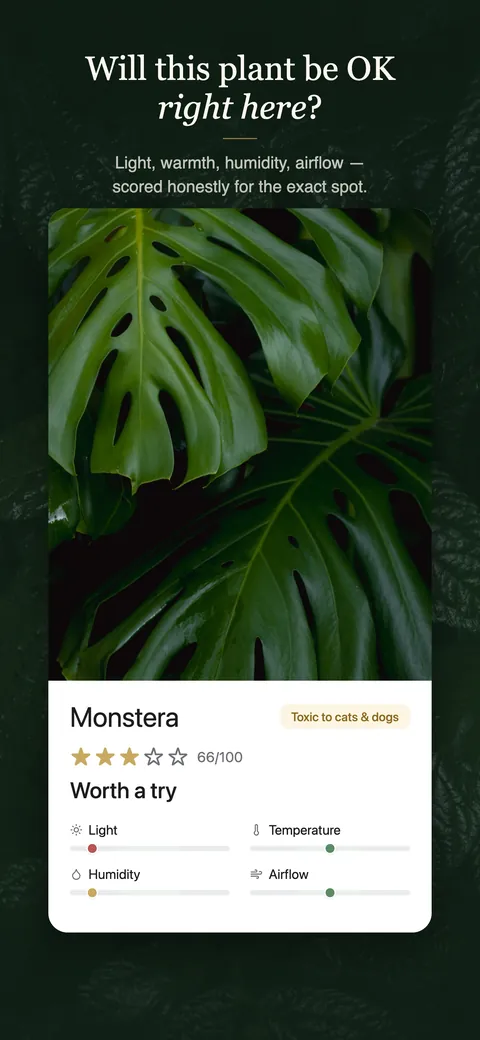
That is a 66 scored from the dim side. ‘Red Valentine’ three metres from east glass gets the same number from the same side, and the fix runs against the answer box’s advice: it wants to come closer to the window.
Where should an aglaonema sit in an east room in winter?
‘Red Valentine’ comes nearer the glass. At latitude 40, about level with Madrid or Denver, the sun on 21 December is weak enough that it reads a little dim from 1.5 m back. The green species gets the sill instead: from 17 October to 23 February the east sill reads a great fit for it.
Summer pushes the green one’s line the other way. On 21 June its flag lasts to 1.30 m and clears at 1.35. Put the two edges together and a shelf 1.35 to 1.45 m from the glass keeps both plants a great fit on all 365 days. If one shelf has to hold a ‘Red Valentine’ and a green one, about four and a half feet back is the place.
Coming forward for winter also brings a pot nearer cold glass, and the west-window page works through what a cool sill costs this plant.
What could make your east window different?
Every row here is an unshaded east window on a clear day. Shade from outside, a tree or the house across the street, takes morning light off the glass before it reaches the room, and these tables can’t see it: on a shaded window the three-metre edge moves in. The east window guide has what else does well in that light, and you can score your own shelf against today’s weather in the free spot checker.
Published November 28, 2026
