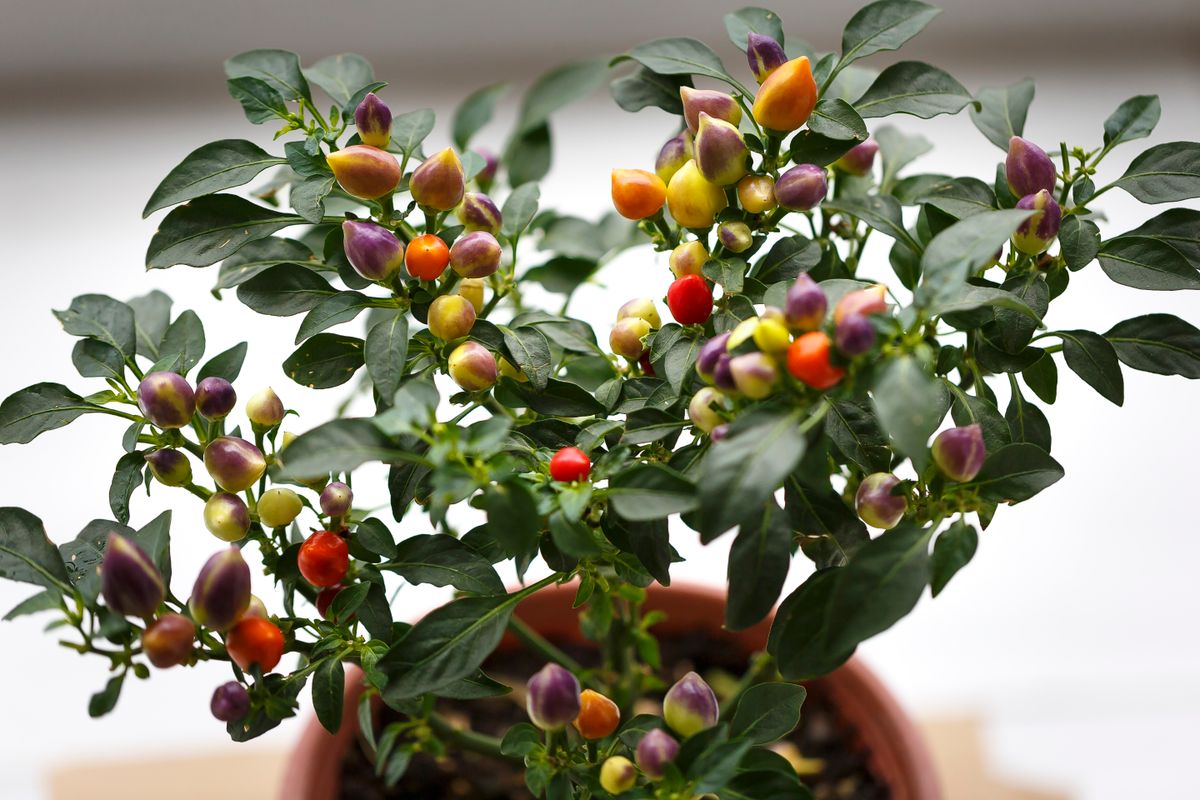
Yes, on the sunniest sill you have, and even that falls a little short. On our scores an ornamental pepper, Capsicum annuum, reads its light just right from 15,000 lux, about 1,394 foot-candles. A bare south sill on a clear day gives 13,000: a little dim, worth a try, and the best spot in a home. A west sill gives 7,800 and an east sill 6,500, both a little dim, and a north sill 3,640, too dim. In winter only the south sill holds: at latitude 40 a west sill reads too dim from 20 October to 20 February and an east sill from 1 October to 11 March, while the south sill stays a little dim on every day of the year. The card below holds a pepper right on a south sill at 21 °C, about 70 °F, with 50% humidity, and scores 68 out of 100. Its lux is modelled for a clear day, not measured in your room.

Worth a try
It can work here with a little care.
A little dim, but workable
Comfortable temperature
Humidity suits it
Airflow suits it
Read on 27 November 2026, Google’s answer box for this question says yes and points to a bright south- or west-facing window, or a grow light for 14 to 16 hours a day. On our scores those two windows part ways in winter, and on a clear day neither reaches the pepper’s band.
Is a south window bright enough for an ornamental pepper?
Nearly. A bare south sill reads it a little dim. Here it is with seven other plants sold for the holidays, on the same sill:
| The holiday plant | What the light is doing | Verdict |
|---|---|---|
| Ornamental pepper (Capsicum annuum) | A little dim, but workable | Worth a try, 68/100 |
| Jerusalem cherry (S. pseudocapsicum) | Just the right amount of light | Great fit, 100/100 |
| Poinsettia (Euphorbia pulcherrima) | Just the right amount of light | Great fit, 100/100 |
| Kalanchoe (Kalanchoe blossfeldiana) | Just the right amount of light | Great fit, 100/100 |
| Amaryllis (Hippeastrum hybridum) | Just the right amount of light | Great fit, 100/100 |
| Lemon cypress (‘Goldcrest’) | Just the right amount of light | Great fit, 93/100 |
| Christmas cactus (S. × buckleyi) | A bit bright, but workable | Worth a try, 66/100 |
| Florist’s cyclamen (C. persicum) | A bit bright, but workable | Worth a try, 61/100 |
Five of the other seven read that light just right: the Jerusalem cherry, a nightshade cousin with round orange fruit, scores 100 there, and so do a poinsettia, a kalanchoe and an amaryllis; a lemon cypress reads it just right too. A Christmas cactus and a cyclamen read it a bit bright. The pepper, at 68, is the only one still short of its band, by 2,000 lux. On that sill it holds a little dim out to 2.1 m from the glass and turns too dim beyond; a west sill holds it to 1 m back, an east sill to 0.6 m, and a north sill is too dim right at the glass.
Does a west window carry an ornamental pepper through winter?
No. Here is the pepper on a west sill on the 21st of eight months at latitude 40:
| The month on the sill | Estimated light | What the light is doing | Verdict |
|---|---|---|---|
| January | 4,429 lux | Too dim here | Not the best fit right now, 46/100 |
| March | 7,746 lux | A little dim, but workable | Worth a try, 64/100 |
| April | 9,305 lux | A little dim, but workable | Worth a try, 65/100 |
| June | 9,360 lux | A little dim, but workable | Worth a try, 65/100 |
| August | 9,322 lux | A little dim, but workable | Worth a try, 65/100 |
| September | 7,773 lux | A little dim, but workable | Worth a try, 64/100 |
| November | 4,377 lux | Too dim here | Not the best fit right now, 46/100 |
| December | 3,900 lux | Too dim here | Not the best fit right now, 46/100 |
From 20 October to 20 February the west sill reads too dim, and from 21 February to 19 October a little dim; an east sill reads too dim from 1 October to 11 March. A bare south sill reads a little dim on every day of the year and is brightest at the glass from September to March, when the low sun reaches straight into the window: our model puts 12,299 lux there on 21 December and 7,319 on 21 June.
How warm should the room be for an ornamental pepper?
Warm. Our care data reads its temperature as ideal from 18 to 30 °C, about 64 to 86 °F, a little cool just below that, and too cold below 15 °C, about 59 °F. Mississippi State’s 70 to 80 degrees for planting outdoors sits inside the ideal. Humidity reads ideal from 40%, a little dry from 25%, and too dry below that.
What do extension services say about ornamental peppers indoors?
Four pages from three universities ask for sun or high light, and two add a grow light:
| Who publishes it | What it says an ornamental pepper needs | When |
|---|---|---|
| extension.msstate.edu | During the late fall and winter, you can grow them indoors | Indoors, late fall and winter |
| extension.msstate.edu | Place your container in a sunny location or use a grow light to provide the necessary light. | Indoors |
| extension.msstate.edu | Ornamental peppers need at least six hours of sunlight each day. | Indoors |
| extension.msstate.edu | they prefer warm temperatures between 70 and 80 degrees | Outdoors |
| plants.ces.ncsu.edu | The peppers require full sun but is heat and drought-tolerant. | In the garden |
| plants.ces.ncsu.edu | Full sun (6 or more hours of direct sunlight a day) | Its light rating |
| franklin.ces.ncsu.edu | The fruit will be at peak color for one to two months and will be brighter and last longer under high light, mild temperatures and moist soil. | As a holiday houseplant |
| franklin.ces.ncsu.edu | The plant can be set outdoors after the danger of frost has passed. | After the holidays |
| ipm.missouri.edu | On the other hand, if a suitable location in the home is available, shade-loving plants such as begonia and impatiens or sun-loving species such as geranium and ornamental pepper might survive indoors. | Brought in from the garden |
| ipm.missouri.edu | Flowering plants that are indoors, particularly those from the garden, need bright light in winter regardless of their light preference outdoors. | Indoors in winter |
| ipm.missouri.edu | Supplemental (artificial) light is beneficial but will have its greatest impact if placed over plants growing with good light from a sunny window. | Grow lights |
Six hours of direct sun is a garden measure; indoors, on our scores, even the bare south sill leaves the pepper a little dim, which fits Missouri’s “might survive”. Missouri puts supplemental light over plants that already have a sunny window, and NC State’s Franklin County office gives the fruit one to two months at peak color, brighter and longer under high light.
For a spot you can’t picture, the free spot checker scores an ornamental pepper against your local weather.
Published November 27, 2026
